Showing posts with label Questioning the Questioners. Show all posts

Monday, September 17, 2012

5 rules for reading "scientific papers" online

This weekend I stumbled in to a very dark place on the internet.

It wasn't political, oh no, it was something much much scarier, with far more demeaning adherents.

It was the world of parenting theory.

I'm not going to name the theory, because quite frankly, I'm afraid they'd find me....but lets just say it's considered pretty fringe by most people.  Don't tell them that though, they went after critics (and even people just asking questions about tiny modifications) with a viciousness that made CNN commenters look rational.

Anyway, as a response to many questions, they kept linking to a paper by a doctor who was part of their movement to prove any and all points.  Finally, I decided to go see what all the fuss was about.

I won't link to it here, because I am seriously scared of these folks, but the paper got me thinking about how often this sort of thing appears on the internet, and things people should look for when consuming "scientific research" that shows up on random websites.  Many readers of this blog are probably already good at this, but for those who may not be so savvy, here we go:


  1. Remember that pretty much anything can call itself a "scientific paper". When I clicked on the link above, I was surprised to find it was really just an opinion piece by a doctor.  While I'll take it at face value that she actually exists and has the credentials she claimed, this was not a peer reviewed paper published in a journal.  That's fine, but calling it a "scientific paper" definitely gave it a little more credit than it deserved....it's like calling something in the supermarket "natural".  It sounds good, and you think you know what it means, but there's really no standard for it.
  2. Beware people who jump around a lot.  I don't mean to be picky, but for the life of me I couldn't figure out what the point of this paper was.  There was no thesis statement, just lots of disjointed "some critics say this" followed by some anecdotes and then the next topic.  It doesn't sound that bad, but believe me, it was.  When I finished I went back through and realized that she was giving just enough rebuttal to raise doubt, but moving on before she had to make a full argument.  Any one of her comebacks would have fallen apart if it had been responded to, but by jumping around with her topics it made you forget what you were objecting to.  Haven't we all had an in person argument like this?  Where the person never responds to a counter argument, they just throw another objection at you?
  3. Follow up on citations.  I had a few minutes to kill while I was reading this paper, so I decided to actually follow the citation trail she gave for her points.  It was amazing how few of them said what she said they said.  Many of them were close, but a few were downright deceptive.  This was uncovered merely by reading the abstract.  I can only conclude they were either mistaken links or the author thought no one would follow up.
  4. Don't presume the citation supports the entire sentence.  This was the most deceptive part of the paper.  At least twice there was a sentence that said something like "You should do A because A leads to B which helps with C and that prevents D from happening, as researcher X has proved"  Now none of these were intuitive connections, all were based on her particular strategy.  When I followed up on researcher X's work, all the paper said was that C prevented D....which was the least controversial statement.  She offered no actual proof that her methods A and B would actually increase C...but her links implied it was there.
  5. Watch out for nitpicking. I know, I'm the last one who should call someone out for nitpicking other people's studies.  However, this is a favorite technique of those trying to prove a point.  They take opposing research, point out a weakness, then proclaim the study invalid because of this.  The problem is that some of it doesn't actually make studies invalid.  Sometimes it's minor things like "those studies on gender pay gap didn't include transgendered persons so they don't really prove anything!".  In this case she faulted the opposition for using too narrow of a definition for one of her recommended practices, and then two paragraphs later mentioned that the narrow definition was really the one she advocated for.
While I stumbled on these in parenting theory, I've seen similar on nutrition/lifestyle websites in particular.  I'm sure there are other examples and other rules.  Would love to hear your thoughts.

Tuesday, September 11, 2012

Kids these days

There's a certain brand of newspaper headline that used to really annoy me when I was a teenager.  At the time I dubbed them "kids these days" headlines....essentially headlines that play to older people's love of fretting over how bad things are in the younger generation.  Prime examples are pretty much on repeat: they're lazy, they're not getting the education the older generation got, they're irresponsible, they're selfish, they like bad music.

I'm over a decade removed from teenagerhood, but my gosh do I still hate those headlines.   I am pretty much of the opinion that every generation has their own pluses and minuses, and we all need to chill out.  Headlines that say "hey, this new generation really figured out a bunch of stuff our target demographic totally screwed up" are just not going to sell.  

ANYWAY, I saw a good example of this in USA Today (via Instapundit)  with the headline "Younger people expect inheritance that won't exist".  

Oh those darn kids!  Always expecting their parents to support them.  Entitled whipersnappers!

First off, this was based on a study done by TD Ameritrade.  For all the issues I have with academic studies, studies done by companies trying to sell you something are even worse.  Also, they almost never release their source data.  

You don't have to look far to see where this one got ridiculous:
Nearly 40% of Generation Z, those ages 13 to 22, expect to receive an inheritance, according to a recent TD Ameritrade study. As a result, they don't believe that they will need to save for retirement.
Seriously? They asked 13 to 22 year olds about their retirement saving ideas and then report that their expectations are unrealistic?  I would be more weirded out if the study had shown that 40% of them had a comprehensive plan in place.  Most 13 to 22 year olds haven't entered the full time workforce yet.

I mean, my retirement accounts are doing fairly well thank you very much, but I opened the first one when I was exactly 22....you know, after I got my first post college full time job.  Coincidentally, that was also the first time I gave any serious thought to the entire concept of retirement.

They don't provide any information about the age distribution of the respondents, but if it was even, 40% of kids in a group of that age range would be 13 to 16.  I've never parented a teenager, but it strikes me that most parents of kids in that age range probably aren't having in depth discussions with them about their financial situation, and certainly not about their retirement savings.  Even those who are teaching financial lessons to their kids probably limit their disclosure about specific numbers.  Asking kids in that age range to have an educated opinion about this is ridiculous.

One more thing....I don't know what kids they polled for this study.  However, the chances that an investment firm polled children of it's own clients is pretty high.  Parents who have investment firm accounts are probably more likely to actually be leaving their kids an inheritance, correct?  It's suspicious to me that they go from their own specific study to a "in general parents aren't leaving their kids money".  How about the kids of these parents?

Alright, that's all I can say without seeing how this study was actually done.  Now get off my lawn.

Tuesday, September 4, 2012

Never go with facts when a pre-existing narrative will do....

Well, the Republican National Convention has come and gone, and I have been too busy with house guests and the new little darling to even watch the much talked about Clint Eastwood speech.  So I can't say I had been too on top of things, though I was a bit surprised to see the headline that the reality show (which I have also not seen) "Here Comes Honey Boo-Boo" had beat the RNC in the ratings.

This morning, in a quiet moment, I was perusing the internets, and found an interesting note in a Gawker article about that headline:
The Hollywood Reporter story titled "Honey Boo Boo Ratings Top the Republican National Convention" that perpetuated this myth went on to state that this victory was in the demographic of adults 18-49, and this results from coverage of the convention being spread over multiple channels. "Aggregate coverage of the RNC across networks obviously eclipsed Honey Boo Boo considerably," Michael O'Connell wrote. Obviously. Considerably.
The media LOVES stories of increasing American ignorance and the decline of civilization.  So much so that they'll rearrange their own numbers to prove how bad things are getting.

It's quite the racket really....create a reality show, report on how this brings media to a new low, then hype it up so people watch it, then start writing stories about how people are watching it.  

Genius.

Saturday, July 28, 2012

Too hot to hire?

....or why psych undergrads would make lousy hiring managers.

I saw this study pop up on Instapundit, and while the number of "that happens to me all the time" jokes are infinite, I'm pretty sad this study got mentioned at all.  Here's the Router's recap:
Attractive women faced discrimination when they applied for jobs where appearance was not seen as important. These positions included job titles like manager of research and development, director of finance, mechanical engineer and construction supervisor.
Oh the sad sad existence of beautiful women.  To work so hard on your career and then get denied a job because you're too attractive.  Now, out of curiosity, exactly how many women got rejected from these jobs for this study?

None.

This study didn't study women or men actually applying for jobs.  They studied what happens when you give a bunch of psych undergrads a huge stack of pictures, a list of job titles and say "sort these pictures in to groups of who you think would be most qualified for a job based solely on the pictures".  Seriously, that's what they did.  Read the full study here.

It turns out that when you ask 65 undergrads (mostly women) to rank a whole bunch (204) of photos of people using no criteria other than what they look like, people might judge other people based on what they look like.  There was some lovely statistical analysis in here, but at no point did they attempt to prove that asking a 20 year old (who presumably had no first hand knowledge about any of the fields other than psych) to sort a picture reflected at all what goes on in hiring offices.

In fact, this is what the "practical implications" section of the paper said:
Although the findings reported here demonstrate the “what is beautiful is good” and “beauty is beastly” effects, it is important to address the likelihood of such stereotypes influencing actual employment decisions. For example, in situations where there is a high cost of making a mistake, as would be the case for a hiring decision, one would expect the decision maker to rely more on individuating information, rather than on stereotypes about physical appearance. However, it is important to note that the bias for the physically attractive, unlike other stereotypes, seems to impact impression formation in a broader range of circumstances. Recent meta-analyses suggest that the what is beautiful is good effect is pervasive, even when the perceiver has additional information about the target   (Hosoda et al., 2003; Langlois et al., 2000). Attractiveness may influence decision  making at a subconscious level, where exposure to an attractive individual elicits positive feelings in the decision maker, causing him or her to judge the target more favorably (Eagly et al., 1991). Moreover, in situations where a decision maker is under a high cognitive load or under time pressure, he or she may be more likely to rely on stereotypes (Fiske & Taylor, 1991; Pendry & Macrae, 1994).
So there is some proof that people favor attractive people no matter what, but no similar proof that they might discriminate against an attractive person if they had real world information.  Which leads me to get a little weirded out by quotes like this from the researcher (in interviews, not the article):
"In every other kind of job, attractive women were preferred," said Johnson, who chided those who let stereotypes affect hiring decisions. 
Putting aside the fact that equality in this case appears to mean that everyone should prefer attractive people....what hiring managers was she chiding?  The ones she never studied?  Since the largest bias against attractive women was found when the mostly female undergrads were asked about who was qualified for male dominated fields....does that say more about what men think about women in non traditional fields, or what women think about women in non traditional fields?

While I'm sure that physical appearance does make a difference in hiring practices, I would have loved to see a little more time dedicated mimicking the real world before announcing that women were facing discrimination in certain professions.  To allow these results to be propagated as proof of what goes on at legitimate companies is a bit of a stretch, and points the finger at people who never even got asked what they would do.  

Friday, July 13, 2012

Moral obligations and Lazy Truth

I was going to include this in a Friday link post, but I really felt it deserved it's own spotlight.  

There's a new gmail gadget called "Lazy Truth" that promises to send you a fact check email every time you receive a (forwarded) email it deems to be of dubious content.

I haven't tried it, so I'm not sure what it's set up to flag, or how accurate the "fact check" email is, but I was immediately intrigued.  I've actually been working on a much longer post that covers just this topic, so it's something I've been giving a lot of thought.

I've been mulling over the rise of Facebook/email/Twitter lately, and wondering.....for those of us who value our integrity and our truthfulness, and do not believe ends justify means, what exactly are the moral implications of hitting forward or share on information that we could have easily proven to be false if we'd checked?

I was wondering if I was the only one worried about this, when I came across a blog post from Dr Michael Eades.  He's a pro-low carb physician, who spends much of his time critiquing nutritional research.  In a post about the book "The China Study", he describes finding what he consider a great critique of it on another person's blog.  Then this:
.... I had fallen victim to the confirmation bias.  My bias was that Dr. Campbell was wrong, so I was more than happy to uncritically accept evidence confirming his error without lifting a finger to double check said evidence myself.  I knew that if a blogger somewhere had come out with a long post describing an analysis of the China study demonstrating the validity of all of Dr. Campbell’s notions of the superiority of the plant-based diet, I would’ve been all over it looking for analytical errors.  But since Ms. Minger’s work accorded with my own beliefs, my confirmation bias ensured that I accepted it at face value. 
Once the fact that I had succumbed to my confirmation bias settled in around me, I became suffused with angst.  I had tweeted and retweeted Ms. Minger’s analysis a number of times, giving the impression that I had at least minimally checked it out and had approved it.  I had emailed it to a number of people, many of whom, I’m sure, had forwarded it on.  I’m sure I played a fairly large role in the rapid dissemination of the anti Campbell/China study info.
In the end, he went back and realized that the post was good, but his panic attack was intriguing to me.  How many of us have had this same panic?  How many of us should have?  How many lousy graphs rip through Facebook like wildfire because no one bothers to double check if they're even valid?  Is the liar the person who created the graph, or do those who share it share some blame?

I don't pretend I have an answer for this.  I feel most of the people interested enough to read this blog probably do not fall in the category of those who would easily share skewed information without thinking about it, but I am hoping for some thoughts/feedback from you all.

Are we so used to hearing politicians of all stripes seamlessly repeat bad data that we've come to view it as acceptable?  Is this just a fact of life?  Is it possible that we will be saved by widgets like the one above?   Does religion matter, or is this an overall moral issue? Does confrontation work with this sort of thing?  Or is this something I just have to learn to live with?

Tuesday, July 10, 2012

19 women don't like sports

Normally this is the sort of thing Joseph's blog specializes in, but I couldn't let this one slide.

I've spent all of last week and this week listening to construction workers traipsing around my basement, working diligently to finish it so we can finally have the sports room my husband's impressive memorabilia collection deserves.  Thus, it distressed me a bit to see the headline that married women only watch sports for the sake of their husbands.  Is my interest in the sports room one big lie? Has my Red Sox fandom all been a fraud?  Should I toss out all my vintage basketball cards from the 80s?  And football.....okay, I actually didn't like it all that much until I got married.  I'll give you that one.  Two out of three ain't bad.

Anyway, I pretty amused when Jezebel and other's quickly pointed out that the sample size for this study was 19.     19 women, all from around the University of Tennessee.  In case you're curious, The Bleacher Report ranked Knoxville the 44th best sports town in the USA.  Maybe my perception is skewed because Boston's #2, but I'm not sure that's an overly representative sample from an overly representative town.

Get some good Southie girls together and ask them what they think, I bet you'll get a wicked different picture.

Thursday, May 24, 2012

More census data....the minority-majority issue

I was happy to see that my post from yesterday  got an excellent comment from Glenn, a former Census Bureau employee.  He let me know that it was likely the sample they used was actually a stratified cluster sample, which is not exactly what I had surmised, but close.

As I was looking up more info on some of the Census Bureau data, I ran in to a fascinating column from Matthew Yglesias over at Slate.com.  In it, he describes his experience filling out the census form, and how his own experience made him question some of the data being released.

In specific, he questioned the recent headline that we are quickly heading towards a minority-majority society.  He mentions that as a 25% Cuban man, he looks very white, but was not sure how to answer the question regarding whether he was "Hispanic in origin".  If he wasn't sure how to answer a race question, how many others were in his boat?  He further comments that as people continue to become increasingly of mixed racial background (keeping in mind that 1 out of 12 marriages is now mixed race) it is much more likely that we will have to shift our concept of what "white" is to keep up with the times.


As Elizabeth Warren can tell you, percentage of heritage matters....but where do we draw the line?  If 3% Native American isn't enough, how much is?  I mean that quite literally.  I don't know.

In my cultural competency class in school, we had a fascinating example of racial confusion.  One of the girls I sat next too mentioned that her grandparents were from Lebanon, had immigrated to South America, her parents were both born there, married, moved to the US, and that's where she was born.  Her skin was fair, she was fluent in Spanish, and she felt she spent her life explaining that she was genetically Arabic, ethnically South American and culturally American.  I don't know what she checked off on the census, but I'm sure nothing captured that particular combination accurately.

As times change, so do our ideas of race. When reading the history of census racial classification, it's hard to disagree with Yglesias' assertion that today's racial breakdown will not be comparable to whatever breakdown we have in ten years.  That's a good thing to keep in mind when analyzing racial data.

 Racial numbers are as good as the categories we have to put them in.   

Wednesday, May 23, 2012

The (ACS) Devil and Daniel Webster

As a New Hampshire native, I am prone to liking people named Daniel Webster.

It is thus with some interest that I realized that the Florida Congressman who is sponsoring the bill to eliminate the American Community Survey happens to share a name with the famous NH statesman.  I have been following this situation since I read about it on the pretty cool Civil Statistician blog, run by a guy who runs stats for the census bureau.

Clearly there's some interesting debate going on here about data, analysis, role of the government, and the classic "good of the community vs personal liberty" debate.

I'm going to skip over most of that.

So why then, do I bring up Daniel Webster?

Well, I was intrigued by this comment from him , as reported in the NYT article on the ACS:
“We’re spending $70 per person to fill this out. That’s just not cost effective,” he continued, “especially since in the end this is not a scientific survey. It’s a random survey.”
It was that last part of the sentence that caught my eye.

I was curious, first of all, what the background was of someone making that claim.  I took a look at his website, and was pleased to discover that Rep. Webster is an engineer.   It's always interesting to see one of my own take something like this on (especially since Congress only has 6 of his kind!).

That being said, is a random survey unscientific?

Well, maybe.

In grad school, we actually had to take a whole class on surveys/testing/evaluations, and the number one principal for polling methods is that there is no one size fits all.  The most scientifically accurate way to survey a group is based on the group you're trying to capture.  All survey methods have pitfalls.   One very interesting example our professor gave us was the students who tried to capture a sample of their college by surveying the first 100 students to walk by them in the campus center.  What they hadn't realized was that a freshman seminar was just letting out, so their "random" survey turned out to be 85% freshman.  So over all, it's probably worse when your polling methodology isn't random than when it is.

There's all kinds of polling methods that have been created to account for these issues:

  • simple random sampling - attempts to be totally random
  • systematic sampling - picking say, every 5th item on a list
  • stratified sampling - dividing population in to groups and then picking a certain percentage from each one (above this would have meant picking 25 random people from each class year)
  • convenience sampling - grabbing whoever is closest
  • snowball sampling - allowing sampled parties to refer/lead to other samples
  • cluster sampling - taking one cluster of participants (one city, one classroom, etc) and presuming that's representative of the whole
There are others, though most subtypes off of these types (see more here).

So what does the ACS use?  

As best I can tell, they use stratified sampling.  They compile as comprehensive a list as they can, then they assign geocodes, and select from there.  So technically, their sampling is both random and non-random.   


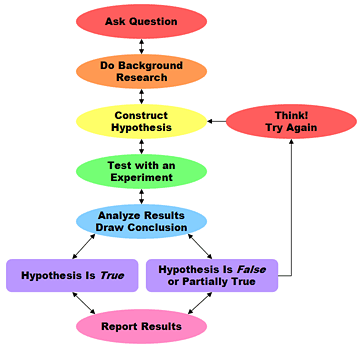
Now, NYT analysis aside, I wonder if this is really what Webster was questioning.  The other meaning one could take from his statement is that he was challenging the lack of scientific method.  As an engineer, he would be more familiar with this than with sampling statistics (presuming his coursework looked like mine).  What would a scientific survey look like there?  Well, here's the scientific method in a flowchart (via Sciencebuddies.org):


So it seems plausible he was actually criticizing the polling being done, not the specific polling methodology.  It's an important distinction, as all data must be analyzed on two levels: integrity of data, and integrity of concept.   When discussing "randomness" in surveys, we must remember to acknowledge that there are two different levels going on, and criticisms can potentially have dual meanings.

Saturday, April 28, 2012

Circumventing the Middle Man

Well, my post on justifiable skepticism (Paranoia is just good sense if people actually are out to get you) certainly was the big winner for traffic/comments this week.  I was happy to see that...I had a lot of fun putting that graph together and thought the outcomes were pretty striking.  Thanks to Maggie's Farm for linking to it.

It was my post on food deserts however, that got me the most IRL comments.  Both my mother and my brother commented on it, and not terrifically positively.  In retrospect, I wasn't very clear about the points I was trying to make, though to be fair I had spent a lot of the day on an airplane.

My issue with food desert research, or any similar research, is that what we're really talking about is a proposed proximate cause to a larger issue: obesity.  In my experience, just having people tell you why they think something's happening, isn't good enough to prove that's the actual reason.  Thus my quibble with much of the theorizing about obesity problems....you have to make sure that what you're theorizing is the cause is actually the cause (or one of the causes) before you start dumping money in to it.  You cannot make the middle man the holy grail if you haven't established that it's really a cause.

Unfortunately, people love to jump on good ideas before truly establishing this link.

Example:  A few years ago, it was discovered that 22% of school children were eating vending machine food.  This school had an obesity problem, the food in the vending machines was unhealthy, so a push began to remove vending machines from schools.  Schools balked, as they make money from vending machines, but the well being of children came first.....until of course this study came out proving that reducing access to vending machines didn't actually effect obesity rates.   Oops.

It's really a simple logic exercise...proving that kids are (a) obese and (b) eating from vending machines does  not actually prove that getting rid of (b) will reduce (a).

That's why I liked the research in to the difference food deserts make in obesity.  It's a question that needs to be asked more often when trying to address a large issue:  are we sure that the issue we're trying to address will actually help the issue we were concerned about it the first place???


If you haven't established that it will, then be careful with how you proceed.  Addressing food deserts (or vending machines or whatever) is  a means to an end, and you shouldn't confuse it with the end itself...unless you have really good data backing you up.

Sunday, April 22, 2012

Bad data vs False Data

We here at Bad Data Bad would like to note that when we pick studies to criticize, we operate under the assumption that what the studies actually published are accurate, and that most of the mistakes are made in the interpretation or the translation of those findings in to news.

This article from the New York Times last week reminds us that this may not always be a good assumption.

A few fabricated papers have managed to make news headlines over the past few years....the Korean researcher who said he'd cloned a stem cell....the UConn researcher who falsified data in a series of papers on the health benefits of red wine....and a Dutch social scientist who faked entire experiments to get his data.

This is where the scientific principle of replication is supposed to step in, and why it's always a decent idea to withhold judgement until somebody else can find the same thing the first study did.  Without that, it's nearly impossible to know if someone falsified their data, without people in their own lab blowing the whistle.

If you're curious about these retractions, the Retraction Watch blog is a pretty good source for papers that get yanked.

Thursday, April 12, 2012

Age Bias and Polling Methods

A few years ago, in one of my research methods classes in grad school, a professor I had asked us to raise our hand if we had a cell phone.  

Everyone raised their hands.  

Then he asked people to keep their hands up if they had a land line as well.  

Many hands went down.  

For those left, he asked how many answered it regularly or had caller ID and screened calls.  

Pretty much everyone.

This of course then led in to a discussion of political polling and how many of us had ever considered who was actually answering these questions.  It was an interesting discussion, as pretty much the entire class admitted they would have self excluded.  The Pew Research center suggests this was not an anomaly, and that this is actually a problem that's becoming more acute in political polling.  

While many large national polling organizations have started calling cell phones as well, on the state level this is not often corrected for.  This can, and has, resulted in some inaccurate polls, as the sample of people home, with a landline, willing to answer a pollsters call, does not always reflect the general population.  Actually, I think there's good reason to question the representativeness of a sample willing to answer their phone for an unknown number, but that could be disputed (those interested enough to pick up the phone also might be more likely to actually go vote).  

Anyway, none of this is new.  What is new this (presidential) election cycle is that news organizations are now starting to put up stats on Twitter and Facebook status updates.  I decided to take a look and see exactly how skewed these stats are, and found that Twitter is most popular in the 18-29 demographic.  Of course, this is the least likely demographic to actually vote.  Interestingly, the poll on Twitter usage did not include people under 18, but these are not excluded when they are compiling trends.  

So two different ways of tracking elections, two different sets of flaws.  Pick your poison.

Tuesday, April 10, 2012

You can't misquote a misquote

Yesterday I talked about sensational statistics and to always verify that there's no missing adjectives that would change the statistic.  It was thus a bit serendipitous that today I happened to hear a debate about a misquoted statistic, and whether the quote or the misquote was more accurate.  It was on a podcast I listen to, and it was about a month old (sometimes I don't keep up well).

It was happening around the time the contraception debate was at it's most furious (see what I did there?  It was a federally mandated coverage of contraception debate, to give you all the adjectives).  Anyway, at the time the statistic about the prevalence of birth control usage among Catholic women was getting tossed around quite a bit.  The statistic, in it's most detailed form, is this:  98% of self-identified Catholic women of child bearing age who are sexually active have used a contraceptive method other than natural family planning at some point in their lives.

Now, this stat rarely got quoted in it's entirety.  First, I always think designating that the religions is self identified is important.  The women answering this survey didn't have to clarify if they thought they were good Catholics, just Catholic.  Second, the "sexually active" got glossed over as well, despite the fact that it probably cuts down the numbers at least a bit (for young adult Catholics, to approximately 89% of respondents).  Third, "at some point".  The study's authors have justified this qualifier by arguing that if a woman is on birth control for years, then decides to start trying to have children and goes off of it, she would have been excluded.  Critics have argued that this strategy was designed to include women who may have tried it, decided it was wrong, and stopped.  Both have a point.

That being said, I most often heard this being quoted as "98% of Catholic women use birth control" or sometimes even "98% of Catholics use birth control".  

It was that last phrase that got the debate going on the show I was listening to.  Person 1 argued that it annoyed him that people kept dropping the "women" part of the quote.  Person 2 shot back that it actually drove him nuts that people felt the need to add it.  He argued that for every straight female using contraception, there was by definition a straight man using it.  Unless one presumed a statistically significant number of women were misleading their partners, 98% of Catholic men were also using birth control (of course, even if they were being misled, they were actually still using it...just not knowingly).  Since according to Catholic doctrine the contraception mandate is for both genders, both parties are therefore guilty.

I liked the debate, and would be totally fascinated to hear the numbers on men who have used (or had a partner who used) contraception.  I am curious if a significant number don't know, or would claim not to know.  I still think that clarifying "women" in the quote is fine, as it's who the study was actually done on.  In my mind extrapolation should always be classified as extrapolation, not an actual finding.

Also of note, this was an in-person survey.  That's always useful to realize that every answer given in a survey like this had to verbalize their answers to another person....important when the topic is anything highly subject to social pressures.  For a further breakdown of issues with that study, see here.

Tuesday, April 3, 2012

Stand Back! I'm going to try SCIENCE!

Today I discovered that my favorite webcomic (xkcd.com) actually has a special comic up if you check it from my employer's server.  Turns out the artist's wife is a patient, doing well, and he wanted to show some love.  This post is thus titled for this shirt, which would make an awesome Christmas present for me, even in April.

Anyway, this weekend I saw this story with the headline "Study: Conservatives' Trust In Science At Record Low".

My first thought on seeing this was that the word "science" is a loaded word.  I mean, I'm as much a science geek as anyone.  Math's my favorite, but science will always be a close second.  But do I trust science? I'm not sure.  Something really bothered me about that question, but I couldn't quite put my finger on it until I read this post on the study from First Things today.  

My love of science makes me a skeptic.  I makes me question relentlessly and then continuously revisit to figure what got left out.  I don't trust science because not trusting your assumptions is science done right.  If we could all trust our assumptions, what would we need science for?  This is the problem with vague questions and loaded words.  Much like the discussion in the comments section of this post where several commenters weighed in on the word "delegate" in relation to household tasks, it's clear that people will interpret the phrase "trust science" in many different ways.

Some might say it means the scientific method, scientists, science as a career, science's role in the world, or something else not springing to mind.  Given the vagueness of the question though, I would have a hard time actually calling anyone's interpretation wrong.  Mine is based on my own bias, but I would wager everyone's is.  So isn't this survey more about how we're defining a phrase than about anything else?

I thought my annoyance was going to end there, I really did.

Then I looked at the graph with the story, and had no choice but to get annoyed all over again.

That's what I get for just reading headlines.

So over the course of this survey, moderates have consistently trusted science less than conservatives for all but four data points?  Why didn't this get mentioned?  I found the original study and took a quick look for the breakdown: 34% self identified as conservative, 39% as moderate, and 27% as liberal.  So 73% of the population has shown a significant drop off in "trust of science" and yet they're somehow portrayed as the outliers?  Science and technology have changed almost unimaginably since 1974, and yet liberal's opinions about all that haven't changed*?  Does that strike anyone else as the more salient feature here?

*Technically this may not be true.  I don't know what the self identified proportions were in 1974, so it could be a self-identification shift.  Still.  This might be that media bias everyone's always talking about.

Tuesday, March 27, 2012

THE KIND OF DATA I ABSOLUTELY HATE

Hate's a strong word.  I get that.  I also get that data and survey types are not always the sort of thing that inspires people to strong hatred, but here we are.

In this post I mentioned my annoyance at perception/prediction polls.  The one I referenced was based on women who didn't change their last names and their level of marital commitment.  Commenter Assistant Village Idiot mentioned another example, which I also liked ""Do you think earthquakes are more likely now because of climate change?" What we think has nothing to do with anything. The earthquakes will happen according to their own rules."  

In writing that post however, I forgot to mention that same study included an even worse piece of data.  As a rebuttal to the "Midwestern college kids don't think non-name changing women are committed" they included a remark that women who didn't plan on changing their names didn't feel less committed. 


I HATE STATEMENTS LIKE THAT.

I would really love it if someone could tell me if there's a proper name for this sort of thing, but I always think of it as "the embarrassing question debacle".  Basically, researchers ask people questions with a potentially embarrassing answer, and then report it as meaningful when people do not answer embarrassingly.

There are only two types of people I have ever heard who will admit they went in to their marriages less than completely committed:

  1. Those who have been married successfully for quite some time who are now comfortable in admitting they were totally naive when they walked down the aisle.
  2. Those who are already divorced and reflecting on what went wrong.
Level of commitment is best assessed in retrospect, and I look with great skepticism at anyone who says they can gauge it before the fact.  

Getting at the reasons people do things can be brutal.  Your only source for your data also has the biggest motivation to conceal it from you.  Some people are actually doing things for good reasons, some just want to look like they are, and some are lying to themselves.  Unless a study at least attempts to account for all 3 scenarios, I would hold all answers suspect.

Monday, March 26, 2012

It's not the question, it's how you ask it

Data gathering is a lot harder than most people imagine.  It's an interesting exercise to take a study and prior to reading it start asking yourself "how would I, if pressed, get the data they claim to have gotten?".  It's amazing how many fall apart quickly when you realize how bad the source data is.

I face this all the time at work.  The simplest questions...what is our demand for transplants? can be a never ending labyrinth of opinion, observation, anecdote, and data....all completely enmeshed.  I spend much of my day trying to untangle these strings, and I never underestimate how difficult getting a simple answer can be.

Factcheck.org ran a great piece today illustrating this challenge.  In a post titled "How Many Would Repeal Obamacare?"  they review 4 different surveys that all try to get to the same number: how many people think healthcare reform should be repealed?

It's a great article that covers sampling practices, question phrasing, date of the poll, and history of the polling organization.

If you looking at the numbers, it shows up pretty quickly that when given dichotomous choices (repeal/keep), people often look like they gave a strong opinion.  In the polls where more moderate answers are given ("it may need small modifications, but we should see how it works), people trend towards that answer.

The phrasing was extremely intriguing though:
“Turning to the health care law passed last year, what is your opinion of the law?”
“If a Republican is elected president in this November’s election, would you strongly favor, favor, oppose, or strongly oppose him repealing the healthcare law when he takes office?”
“Do you think Congress should try to repeal the health care law, or should they let it stand?”

In one, the question focuses on personal opinion, in the next the focus is the presidency, in the third it's Congress.  All of this for a law that most Americans have yet to feel the effects of in any practical way.

Of course this is not to say that a public opinion poll (or 4) makes one side right or wrong. If constitutionality or effectiveness are your concern, nothing here addresses either.  I am enjoying it immensely for the educational value though, and kind of wishing I was teaching a class so I could use this as an example.  Those of us in Massachusetts do have the luxury of sitting back and just sort of pondering all of this....as this has been our world for 7 years now.

That reminds me....were these samples controlled for that????