Showing posts with label Correlation and Causation. Show all posts

Thursday, September 27, 2012

Pacifiers and baby boys

I'm a bit behind on this one, but this study was too interesting to pass up.

Apparently, research suggests that pacifier use by boys limits their social development.

So we'll start with the bias alert.  I have a baby boy, and he does use a pacifier to help him go to sleep.  I didn't have any particular feelings about this, I just gave it a whirl and liked the way it helped him calm down when he was tired.  Give it 5 minutes, and he tends to spit it out and go to sleep.  That seemed rational to me, I actually was unaware there was much controversy about this until I got reading this article (reiterating Dubbahdee's point that I should never read parenting advice on the internet....oops).

Obviously, I don't yet know what his social development is going to turn out like (though at the moment he's astoundingly unsympathetic to my lack of sleep), but I generally hope it's okay.   End bias alert.

It took me a while to find the actual paper (why oh why do so many news sources not link to the actual paper????), but after scanning the whole thing I had a couple thoughts.

The headlines about this paper were stupid, of course.  The author actually had a pretty good theory based on actual science (babies learn emotions in part through mimicry, she wondered if a pacifier would make this harder for babies because their facial muscles were occupied), and of course it got over reported. Most headlines just mentioned "pacifier use" in general, but she clarifies pretty quickly that they only studied pacifier use during baby wake time....specifically excluding the type of pacifier use I described above (as a sleep aid).  This makes sense (the woman does have 3 boys herself after all) because you don't have to spend very long around babies before you realize they're probably not learning much when they're trying to fall asleep.  They're mostly just crying.

Anyway, the set up for the study was pretty good.  They assessed both 6 and 7 year olds and their emotional reactions vs pacifier use, and then later college students who were questioned about their history of pacifier usage to tie it to adult development.

For that second, I was curious about the length of pacifier use we were talking about, as this was based on the recollection of college students and their parents, and I was wondering how accurate that would be.  This graph sums it up nicely:

I'm not familiar with the emotional intelligence scale they're using, so I'll take their word for it that 4.7 to 4.4 is statistically significant....but wow, daytime use of a pacifier until 5 years of age?  That does seem like it should cause some concern.  Also, it seems as those the recollection bias here would be clustered at either end.  Parents would remember more accurately either remarkably short or remarkably long pacifier use...but that's just a guess.

Overall, I thought it was annoying that "daytime use of pacifiers until kindergarten" got labeled as just "pacifier use", but I thought the research was certainly intriguing.  I especially liked that they tested both younger children and adults to help prove their theory, as emotional development is most definitely a complex process that takes decades to work through.

What I actually liked about this study the most was Ann Althouse's take on it.  She wondered if this meant you could stop overly emotional women from being overly emotional by giving them Botox so they couldn't mimic those around them.  I'd say it's worth a shot.

Sunday, August 19, 2012

Does egg = cigarette?

Oh CNN, your headlines make me sad sometimes.

Is eating egg yolks as bad as smoking?

No.  No it is not.  The study you're reporting on does in fact claim that eating egg yolks accelerate heart disease about 2/3rds as much as smoking does, but acceleration of heart disease is not actually the health problem smoking is most known for.  But you know that.  Sigh.

Not that I'm buying the study anyway.  They asked people, who already had heart disease, to report their egg yolk consumption over the course of their lives.  How accurately can you recall your average egg yolk consumption over the course of your life?  Additionally, people who have heart disease have most likely been told to cut down on consumption of saturated fat and cholesterol.  Those still eating more eggs have likely heard this advice, and disregarded it.  What are the chances that they're disregarding other advice as well?  Lastly, it does not appear the study asked about the consumption of any other food, meaning egg consumption could actually just be co-occuring with the consumption of something else that was even worse.  Surveys that ask only about very specific foods tend to see what they want to see.

So basically, another correlation/causation issue here, combined with those terrible consumption recollection surveys, with a sprinkle obnoxious headline writing.   Yeehaw.


Tuesday, July 24, 2012

Correlation and Causation - Abortion and Suicide meet the 8th circuit

Perhaps it's lawyer's daughter in me, but I think watching courts rule on presentation of data is totally fascinating to me.

Today, the 8th Circuit Court of Appeals had to make just such a call.

The case was Planned Parenthood v Mike Rounds and was a challenge to a 2005 law that required doctors to inform patients seeking abortions that there was "an increased risk of suicide ideation and suicide".  This was part of the informed consent process under the "all known medical risks" section.

Planned Parenthood challenged on the grounds that this was being presented as a causal link, and was therefore was a violation of the doctor's freedom of speech.

It's a hot topic, but I tried to get around the controversy to the nuts and bolts of the decision. I was interested how the courts evaluated what research should be included and how.

Apparently the standard is as follows:

...while the State cannot compel an individual simply to speak the State’s ideological message, it can use its regulatory authority to require  a  physician to provide  truthful,  non-misleading  information relevant to a patient’s decision to have an abortion, even if that information might also encourage the patient to choose childbirth over abortion.”  Rounds, 530 F.3d at 734-35; accord Tex. Med. Providers Performing Abortion Servs. v. Lakey, 667 F.3d 570, 576-77 (5th Cir. 2012).  
So in order to be illegal, disclosures must be proven to be "“either  untruthful, misleading or not relevant to the patient’s decision to have an abortion."


It was the misleading part that the challenge focused on.  The APA has apparently endorsed the idea that any link between abortion and suicide is NOT causal.  The theory is that those with pre-existing mental health conditions are both more likely to have unplanned pregnancies and to later commit suicide. It was interesting to read the huge debate over whether the phrase "increased risk" implied causation (the court ruled causation was not implicit in this statement).


Ultimately, it was decided that this statement would be allowed as part of informed consent.  The conclusion was an interesting study in what the courts will and will not vouch for:

We acknowledge that these studies, like the studies relied upon by the State and Intervenors, have strengths as well as weaknesses. Like all studies on the topic, they must make use of imperfect data that typically was collected for entirely different purposes, and they must attempt to glean some insight through the application of sophisticated statistical techniques and informed assumptions. While the studies all agree that the relative risk of suicide is higher among women who abort compared to women who give birth or do not become pregnant, they diverge as to the extent to which other underlying factors account for that link.  We express no opinion as to whether some of the studies are more reliable than others; instead, we hold only that the state legislature, rather than a federal court, is in the best position to weigh the divergent results and come to a conclusion about the best way to protect its populace.  So long as the means chosen by the state does not impose an unconstitutional burden on women seeking abortions or their physicians, we have no basis to interfere.
I did find it mildly worrisome that the presumption is that the state legislators are the ones evaluating the research.  On the other hand, it makes sense to put the onus there rather than the courts. It's good to know what the legal standards are though....it's not always about the science.

Monday, May 21, 2012

Correlation and Causation: Real World Problems

In yesterday's post, I got a bit worked up over sloppy reporting on a study on dietary interventions in pregnancy. 

This led to an interesting comment from the Assistant Village Idiot regarding weight gain recommendations for pregnant women.  The current weight gain recommendation is 25 - 35 pounds for a normal BMI woman, but AVI commented that it used to be much lower, and that women were hospitalized to stop them from eating too much.

I didn't actually know that, so I immediately decided to look it up.  

I stumbled on to a fascinating presentation put together by an OB at UCSF on the history of maternal weight gain recommendations (link goes to the PowerPoint slides).  It not only confirmed what AVI had mentioned, but also gave some of the reasoning....which turned out to be a very interesting example of people erroneously conflating correlation with causation.  

Apparently part of the reason why they (they being doctor's circa 1930) were so nervous about weight gain in pregnancy was that they were trying to prevent preeclampsia.  Now preeclampsia is a life threatening condition if left untreated, and one of the warning signs is rapid weight gain.  Apparently some doctors actually thought that the symptom was the cause, and believed that all excessive weight gain was a sign the patient was about to become preeclamptic.  Thus, the theory went, limiting weight gain would prevent preeclampsia and aid in "figure preservation" to boot*.  

Sadly, this also led to higher infant mortality, disability, and mental retardation....which seems a pretty steep price to pay for what was really a data analysis error.  As I've said before, this is why statistics are so relevant in medicine....the cost for getting things wrong is too steep to not be careful.

*To note, it is actually true that preeclampsia is linked to higher weight/glucose/insulin production....but the way they went about addressing it did as much harm to the fetus as good.  Current weight gain recommendations are set to optimize outcomes for the babies, not the mothers.  

Wednesday, May 16, 2012

Correlation and Causation: the Teen Pregnancy Edition

One of the first posts I ever did was on correlation and causation.  In it, I spelled out the three rules to consider whenever two variables (x and y) are linked:


  1. X is causing Y
  2. Y is causing X
  3. Something else is causing both X and Y
While most people jump to the conclusion that it's number 1, Matthew Yglesias wrote a piece for Slate.com this week where he rather awkwardly jumps to conclusion number 2.  

He starts off well with the second paragraph, but then goes to very strange place in the third: 

Delivering the commencement address last weekend at the evangelical Liberty University, Mitt Romney naturally stuck primarily to “family values” and religious themes. He did, however, make one economic observation that intersects with some fascinating new research. “For those who graduate from high school, get a full-time job, and marry before they have their first child,” he said, “the probability that they will be poor is 2 percent. But if [all] those things are absent, 76 percent will be poor.”
These are striking numbers, but they raise the age-old question of correlation and causation. Does this mean that the representative high-school dropout would be doing much better had he stuck it out in school for a few more years? Or is it instead the case that the population of high-school dropouts is disproportionately composed of people who have attributes that lead to low earnings?
When it comes to early pregnancy, surprising new evidence indicates that Romney and most everyone else have it backward: Having a baby early does not hamper a young woman’s economic prospects, as Romney implies. Rather, young women choose to become mothers because their economic outlook is so objectively bleak.
Say what?

As a former teenage girl myself, this is a strange conclusion....I certainly never met a teen mom who would have put it that way.  But surely there was some wonderful evidence to support this scathing conclusion?

Well, not really.  Here's the original paper....and  here's how the authors conveyed their thoughts:

We describe some recent analysis indicating that the combination of being poor and living in a more unequal (and less mobile) location, like the United States, leads young women to choose early, non-marital childbearing at elevated rates, potentially because of their lower expectations of future economic success. ...These findings lead us to conclude that the high rate of teen childbearing in the United States matters mostly because it is a marker of larger, underlying social problems.
The emphasis was mine....but notice how much more careful they are in their language.  If you take my list above, you see that they are challenging possibility number 1, seeing if #2 is a feasible conclusion, but ultimately pointing the finger at #3....i.e. "larger, underlying social problems".

For example, the cite low maternal education as a risk factor for teen pregnancy...which one could presume could be either the result of or the cause of low income.

Teen pregnancy is complicated, and honestly I would be very surprised if you could ever figure out a way to pin it on just one factor.  Additionally, so much information is unavailable that it can be hard to parse through what you have left.  A key factor in all of this would be to determine if higher income girls weren't having babies because they weren't getting pregnant or because they were having abortions....data which could lead to very different conclusions.

I fully support this study, by the way, questioning the prevailing wisdom is always a good thing. What I resent is when people think just by flipping the order of a normal conclusion that they're being clever.

X could cause Y, Y could cause X, something else could be causing both.

Then again, it could also just be a coincidence.  

Sunday, April 29, 2012

Weekend Moment of Zen 4-29-12

Since my mother still doesn't agree with any of my food desert postings, I thought of this comic.

Mom, I think we should consider that maybe obesity causes food deserts.  Think about I'm pretty sure I heard about obesity before I heard the phrase food desert.  I'm pretty sure that proves something.

Saturday, April 28, 2012

Circumventing the Middle Man

Well, my post on justifiable skepticism (Paranoia is just good sense if people actually are out to get you) certainly was the big winner for traffic/comments this week.  I was happy to see that...I had a lot of fun putting that graph together and thought the outcomes were pretty striking.  Thanks to Maggie's Farm for linking to it.

It was my post on food deserts however, that got me the most IRL comments.  Both my mother and my brother commented on it, and not terrifically positively.  In retrospect, I wasn't very clear about the points I was trying to make, though to be fair I had spent a lot of the day on an airplane.

My issue with food desert research, or any similar research, is that what we're really talking about is a proposed proximate cause to a larger issue: obesity.  In my experience, just having people tell you why they think something's happening, isn't good enough to prove that's the actual reason.  Thus my quibble with much of the theorizing about obesity problems....you have to make sure that what you're theorizing is the cause is actually the cause (or one of the causes) before you start dumping money in to it.  You cannot make the middle man the holy grail if you haven't established that it's really a cause.

Unfortunately, people love to jump on good ideas before truly establishing this link.

Example:  A few years ago, it was discovered that 22% of school children were eating vending machine food.  This school had an obesity problem, the food in the vending machines was unhealthy, so a push began to remove vending machines from schools.  Schools balked, as they make money from vending machines, but the well being of children came first.....until of course this study came out proving that reducing access to vending machines didn't actually effect obesity rates.   Oops.

It's really a simple logic exercise...proving that kids are (a) obese and (b) eating from vending machines does  not actually prove that getting rid of (b) will reduce (a).

That's why I liked the research in to the difference food deserts make in obesity.  It's a question that needs to be asked more often when trying to address a large issue:  are we sure that the issue we're trying to address will actually help the issue we were concerned about it the first place???


If you haven't established that it will, then be careful with how you proceed.  Addressing food deserts (or vending machines or whatever) is  a means to an end, and you shouldn't confuse it with the end itself...unless you have really good data backing you up.

Monday, April 23, 2012

Paranoia is just good sense if people really are out to get you

Yesterday I posted about retractions in scientific journals, and the assertion that they are going up.  I actually woke up this morning thinking about that study, and wishing I could see more data on how it's changed year to year (yes, I'm a complete nerd...but what do you ponder while brushing your teeth????).  Anyway, that brought to mind a post I did a few weeks ago, on how conservatives trust in the scientific community has gone steadily down.

It occurred to me that if you superimposed the retraction rate of various journals over the trust in the scientific community rates, it could actually be an interesting picture.   It turns out PubMed actually has a retraction rate by year available here.  For purposes of this graph I figured that would be a representative enough sample.

I couldn't find the raw numbers for the original public trust study, so these are eyeballed from the original graph in blue, with the exact numbers from the PubMed database in green.  

So it looks like a decreasing trust in the scientific community may actually be a rational thing*.  

It's entirely possible, by the way, that the increased scrutiny of the internet led to the higher retraction rate...but that would still have given people more reasons not to blindly trust.  As the title of this post suggests, skepticism isn't crazy if you actually should be skeptical.

Speaking of trust, I obviously had to manipulate the axes a bit to get this all to fit.  Still not sure I got it quite right, but if anyone wants to check my work, the raw data for the retraction rate is here and the data for the public trust study is here.  These links are included earlier as well, just wanted to be thorough.  

*Gringo requested that I run the correlation coefficients.  Conservatives r = -0.81 Liberals r = 0.52 Moderates r = 0.  I can't stand by these numbers since my data points were all estimates based on the original chart, but they should be about correct.

Thursday, March 29, 2012

Why most nutritional research is useless

Nutrition research is big money these days.  Our national obsession with weight loss is at a fever pitch, and any new or interesting research is sure to make headlines.


Here's some basic guidelines on what to look for in nutritional research (any study, not just this one):
  1. Was the data self reported? Even CNN brought this up in their article.  People, especially those embarrassed about their weight, don't accurately assess what they eat.  My mother, skinny little thing that she is, could eat one peppermint patty and tell you she'd had a serving of chocolate.  I don't think I'd even count it until I had 3 or so.
  2. How much was "more"? I actually can't find this for this study.  Is it the difference between 1 and 2 servings per week?  Or the difference between 1 and 5?  Both would produce statistically significant correlations, but the practical outcome would be different.  In 2005, researchers made news by saying that eating more fruits and veggies did not, in fact, prevent cancer.  The cancer treating establishment (which I work in, btw) promptly responded by pointing out that they compared people who ate half a fruit per day to those who at 1-2 fruits per day.  It was all reported in grams too, so the data look extra impressive "Those eating less than 114 grams showed no difference from those eating 367 grams".  The link gives more examples, but 250 grams is one medium apple.  Watch out for this.
  3. Who classified people as "normal weight" or "overweight"?  If this was also self reported (and in this study, it looks like there were clinic visits), then look out.  There's a great study I can't find right now that shows that women tend to lie about weight, and men tend to lie about height.  Both lies will screw up the BMI calculation (the most common metric for assessing "normal").
  4. Were the overweight people actively (or even somewhat) trying to modify their diets to lose weight?  A few years ago, I heard about the study that suggested diet soda was linked to obesity.  I remember my first reaction was "are we sure they're all not just on diets?".  This seemed like a classic correlation/causation issue.  All the analysis seemed to presume they were overweight because they drank diet soda.  I wondered why they never seemed to look at the idea that they could be drinking diet soda because they were overweight.  That's one of the first swaps most people I know make when they try to lose weight.  
  5. Don't even get me started if it's a population study.  That's a big topic for another time, but lets just say they're really really tricky.
If you ever want a fabulous crash course in how nutrition research can be skewed, pick up two diet books that contradict each other, and read through their parts on research.  Take something like Atkins (high protein, low carb) and Joel Fuhrman (nearly vegan), and watch them rip to shreds the research the other one builds their whole case on.  

He may have his own controversy, but this is why I like Michael Pollan.  The book I linked to has a great crash course in why most nutritional research just sees what it wants to.  He refused to take a strict nutritional stance and instead condensed it down to a few "rules" that he gleaned from quizzing nutritionists on "what they could say for sure".  The answer? Eat real food, not too much, mostly plants.  

Sunday, March 25, 2012

Correlation and Causation: the Housework Edition

After yesterday's comic, I was hoping to find a good example of a news story where they equated correlation and causation.  In case you're curious, it took me under 5 minutes.

Headline: Why Being Less of a Control Freak May Make You Happier

To start, let me just mention that correlation implies that two things are moving together....as one goes up, so does the other.  Alternatively, as one goes up, the other goes down, or vice versa.  Either way, their outcomes appear to be tied.

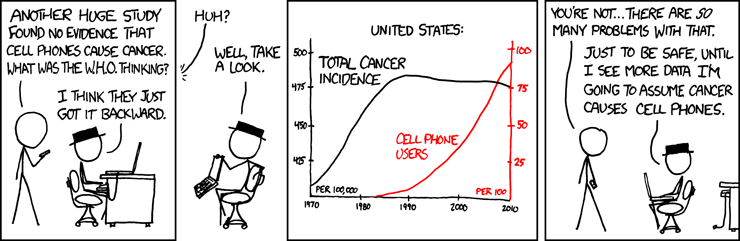
Causation on the other hand, says that one thing is causing another.  What yesterday's post was referring to is the often made mistake that just because two things are correlated, we can infer that one is causing the other.  This is not always true, and believing so may get you drawn as a stick figure.  

Anyway, the article above illustrates that point nicely.  The author set out to find out if being a control freak mom made people unhappy....and low and behold it appears to.  55% of women who said they delegate to a partner or spouse at least once a week reported themselves as "very satisfied" with their life.  For those who did not delegate that often, the number was 43%.  

Now, I'll mostly skip the use of the word "delegate" in this article, though it does bother me.  My husband does plenty around the house, but we mostly just consider that "teamwork" not "delegating".  I don't start the week handing out tasks to him, and he doesn't consider the work he does around the house a favor to me.  It's just what needs to get done.

More importantly however, is the articles conclusion that delegating will make people happier.  While delegating and happiness are perhaps correlated, they are not necessarily causal.  It's possible that the women who don't delegate do so because their spouse is lazy, hostile, or generally not involved....all things which would also make them less happy over all.  It's also possible that women who don't delegate are controlling, martyr's, passive aggressive, etc, and that makes them unhappy too.

I had a great stats professor once who opened every class with this:

"If you get one thing out of this class, let it be this:

When x and y or correlated, you have 3 possibilities:

  1. X is causing Y
  2. Y is causing X
  3. Something else is causing both X and Y "
Lack of delegating could cause unhappiness.
Unhappiness could cause people to stop delegating.
Something else entirely could cause people to not delegate and to be unhappy.