Thursday, July 26, 2012

Tracking the wild bad data

As someone who spent 3 years studying family dynamics in grad school, I was pretty interested in the NYT piece that ran last week on class divides in single vs married households.  The article generated a lot of buzz, and if you haven't read it, I would recommend it.

People seemed to either love or hate this article, and it's stirred up a whole lot of discussion online.  One of the more interesting points that got brought up though, was a discussion about why the focus was on single moms as opposed to deadbeat dads.

This led to some quoting of an interesting statistic regarding custodial parents and child support.  When I first read this statistic, it was from Amanda Marcotte over at Slate who put it this way:
.... in a substantial number of cases, the men just quit their families. That's why only 41 percent of custodial parents receive child support.
Now, I've perused internet comment boards enough to know that there are a LOT of men out there griping about how much they pay in child support.  I was a little shocked to read that apparently 59% don't give anything.  I clicked on the closest link she had provided.....which took me over to the NYT Economix blog and an item by Nancy Folbre. There was the stat again, except with a few more qualifiers:
In 2009, the latest year for which data are available, only about 41 percent of custodial parents (predominantly women) received the child support they were owed. Some biological dads were deadbeats. 
So that frames it a little differently.  It's still a little unclear from that statement, but it started to occur to me that this probably meant only 41% were up to date on their support payments...not that only 41% of non-custodial parents were paying.

I clicked on the link provided by Folbre, and got to the Census Bureau website, which put it all this way:
 In 2009, 41.2 percent of custodial parents received the full amount of child support owed them, down from 46.8 percent in 2007, according to a report released today by the U.S. Census Bureau. The proportion of these parents who were owed child support payments and who received any amount at all — either full or partial — declined from 76.3 percent to 70.8 percent over the period.
Now that's still a lot of deadbeats, but it is a slightly different picture from the one we originally started with.  When I clicked on the link from the Census Bureau snapshot to the report it originally came from, I noticed something else interesting....only about half of all custodial parents have court ordered support, and the non-payment stats above appear to reflect only what is happening in the court ordered cases.  The non court ordered cases are certainly hazy....30% of custodial parents said they never went to court because they knew the other person couldn't pay....but it is interesting that the quoted stats only apply to half of the custodial parent cases.

Overall, I must say I kind of enjoyed attempting tracking the evolution of a stat (in reverse).  It's not often you get to actually see how things evolve from the primary source to several steps out....and it was an interesting mental exercise.  Thanks for taking the journey with me.

Wednesday, July 25, 2012

Review and redraft - research in government

A few months ago, my father let me know that New Hampshire had passed a law that required the various government agencies to update their rules/statutes every few years (5 years? 7 years? Dad, help me out here).  I'm not entirely sure what the scope of this law was, but my Dad mentioned that it was actually quite helpful for his work at the DMV.  It had surprised him how many of their rules did not actually reflect the changing times, and how helpful it was to update them.  One of the biggest rules they had found to update was that in certain situations, they were still only allowed to accept doctor's notes from M.D.s....so anyone who used a nurse practitioner for primary care couldn't get an acceptable note....despite NPs being perfectly qualified to comment on the situations they were assessing.  It wasn't that the note needed to be from an MD, it was just that when the rule was written, very few people had anything other than a primary care MD.  I found the entire idea pretty good and proactive.

I was thinking about that after my post yesterday on South Dakota's law regarding abortion risk disclosure.  I was wondering how many, if any, states require that laws based primarily on current scientific research  review those laws in any given time period.

Does anyone know if any states require this?  Or is this solely up to those who oppose certain laws to challenge things later?  

Tuesday, July 24, 2012

Correlation and Causation - Abortion and Suicide meet the 8th circuit

Perhaps it's lawyer's daughter in me, but I think watching courts rule on presentation of data is totally fascinating to me.

Today, the 8th Circuit Court of Appeals had to make just such a call.

The case was Planned Parenthood v Mike Rounds and was a challenge to a 2005 law that required doctors to inform patients seeking abortions that there was "an increased risk of suicide ideation and suicide".  This was part of the informed consent process under the "all known medical risks" section.

Planned Parenthood challenged on the grounds that this was being presented as a causal link, and was therefore was a violation of the doctor's freedom of speech.

It's a hot topic, but I tried to get around the controversy to the nuts and bolts of the decision. I was interested how the courts evaluated what research should be included and how.

Apparently the standard is as follows:

...while the State cannot compel an individual simply to speak the State’s ideological message, it can use its regulatory authority to require  a  physician to provide  truthful,  non-misleading  information relevant to a patient’s decision to have an abortion, even if that information might also encourage the patient to choose childbirth over abortion.”  Rounds, 530 F.3d at 734-35; accord Tex. Med. Providers Performing Abortion Servs. v. Lakey, 667 F.3d 570, 576-77 (5th Cir. 2012).  
So in order to be illegal, disclosures must be proven to be "“either  untruthful, misleading or not relevant to the patient’s decision to have an abortion."


It was the misleading part that the challenge focused on.  The APA has apparently endorsed the idea that any link between abortion and suicide is NOT causal.  The theory is that those with pre-existing mental health conditions are both more likely to have unplanned pregnancies and to later commit suicide. It was interesting to read the huge debate over whether the phrase "increased risk" implied causation (the court ruled causation was not implicit in this statement).


Ultimately, it was decided that this statement would be allowed as part of informed consent.  The conclusion was an interesting study in what the courts will and will not vouch for:

We acknowledge that these studies, like the studies relied upon by the State and Intervenors, have strengths as well as weaknesses. Like all studies on the topic, they must make use of imperfect data that typically was collected for entirely different purposes, and they must attempt to glean some insight through the application of sophisticated statistical techniques and informed assumptions. While the studies all agree that the relative risk of suicide is higher among women who abort compared to women who give birth or do not become pregnant, they diverge as to the extent to which other underlying factors account for that link.  We express no opinion as to whether some of the studies are more reliable than others; instead, we hold only that the state legislature, rather than a federal court, is in the best position to weigh the divergent results and come to a conclusion about the best way to protect its populace.  So long as the means chosen by the state does not impose an unconstitutional burden on women seeking abortions or their physicians, we have no basis to interfere.
I did find it mildly worrisome that the presumption is that the state legislators are the ones evaluating the research.  On the other hand, it makes sense to put the onus there rather than the courts. It's good to know what the legal standards are though....it's not always about the science.

Monday, July 23, 2012

Political ages...mean vs median?

I just found out The Economist has a daily chart feature!

Today's graph about age of population vs age of cabinet ministers is pretty fascinating:
It did leave me with a few questions though.....who did they count as cabinet ministers?  I don't know enough about the governments in these countries to know what that equates to.  Also, why average vs median?  

I initially thought this chart might have been representing Congress, not the Cabinet.  I took a look at my old friend the Congressional Research Service Report and discovered that at the beginning of the 112th Congress in 2011, the average age was  57.7 years, which would make this chart about right.  I had to dig a bit further to get the ages of the Cabinet, but it turns out their average age is 59.75.  I was surprised the data points would be so close together actually....especially since that 57.7 was for Jan 2011, so it's actually 59.2 or so now.  

In case you're curious, 7 members of the cabinet are under 60.  The youngest is Shaun Donovan (46), Department of Housing and Urban Development.  The oldest is Leon Panetta (74), Department of Defense. Panetta is actually the only member over 70.  Half of them are in their 60s, 5 in the 50s, and 2 in their 40s.  

I felt a little ashamed I only could have given name/position to 5 of them before looking them all up.  That's not great, especially when you realize I'm counting Biden.  Still, I comforted myself with the fact that I bet that beats a very large percentage of Americans.  

A quick look for other data suggests that median age of populations is the more commonly reported value.  The median age of the cabinet was actually 61, in case you're curious.

Sunday, July 22, 2012

Weekend Moment of Zen 7-22-12

This is a useful flowchart/infographic from Lapham's Quarterly for those who routinely get accused of witchcraft:

Hopefully your weekend went well enough that you didn't need this.  Otherwise I'd feel bad I didn't post it earlier.

Saturday, July 21, 2012

Are law schools liable for misleading statistics?

An interesting snippet from over at the Volokh Conspiracy, where former students sued their law school for publishing misleading statistics.

The court ruled that the salary statistics published by the school were truly misleading, but in the end caveat emptor prevailed.  Apparently the schools had published average salary data, but only for those students who actually got jobs.  The court ruled that:
....even though Plaintiffs did not know the truth of how many graduates were used to calculate the average salary, at the very least, it is clear that the Employment Report has competing representations of truth. With red flags waiving and cautionary bells ringing, an ordinary prudent person would not have relied on the statistics to decide to spend $100,000 or more.
I do love legal language at times, and I was fairly amused by the phrase "competing representations of truth". While in this case it was clear cut what information would have been most useful to the consumer, it's often unclear what statistical breakdown represents "actual reality" and such.  I did think that perhaps the court was giving the public too much credit though, when it cited what an "ordinary prudent" person would do (or is it just that not many prudent people exist?).

I've been reading Tom Naughton's blog quite a bit lately, and he often quotes his college physics professor's advice to all of his students.  It's a good quote, one that I think should be taught to all students freshmen year of high school.  In fact, it should have been used in this court decision:  "Learn math.  Math is how you know when they're lying to you."


Friday, July 20, 2012

For the philosophy majors

My younger brother's in town, which means I'm going to wind up having some excellent philosophical debates over the next few weeks.

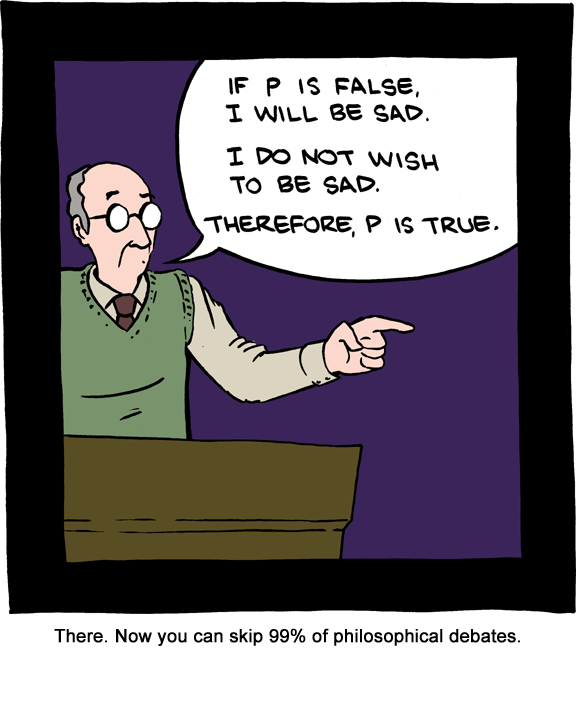
I like these sorts of debates because they are pretty easy to deconstruct, as opposed to scientific or data analysis debates.  Saturday Morning Breakfast Cereal managed to condense the summary in to one panel:
Glad you're around little brother!  Missed you!